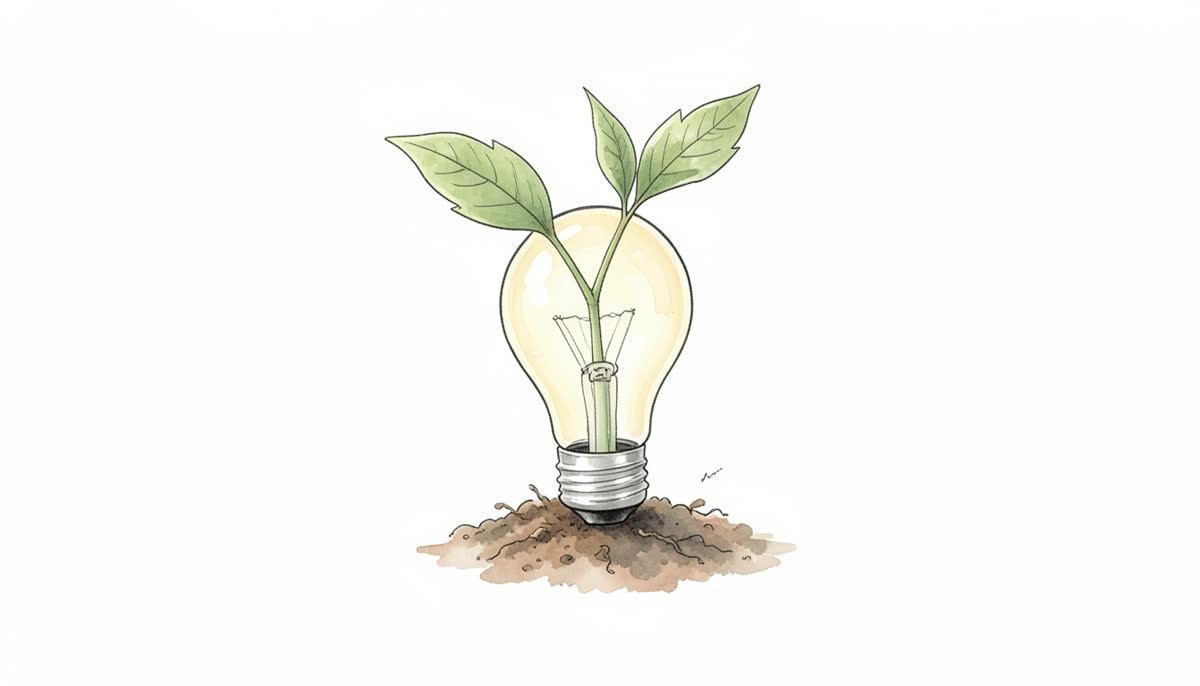
The Barrier That Disappeared
Only a few years ago, anyone with an idea for a website, an app or a short film ran into a wall of skills: they had to learn to code, design or edit video, or pay someone who could. Many ideas died at that wall, not because they were weak, but because their owners lacked the time or money to get over it.
Today the picture has changed. AI tools write code, free design and editing software has reached studio level, and what once took a team months can now be done in days or hours. In other words, the cost of execution has dropped close to zero, and the barrier between skill and idea has all but vanished.
The logical result: if everyone can make something, what sets one maker apart is no longer "can they make it?" but "what do they choose to make?" That is where a good idea becomes more valuable than ever.
But the Idea Alone Isn't Enough
There's an old debate among entrepreneurs: which matters more, the idea or the execution? Writer and entrepreneur Derek Sivers summed it up in a well-known post, "Ideas are just a multiplier of execution": a brilliant idea with no execution is worth almost nothing, and its real value appears only when it's multiplied by the quality of the execution.
So what changed? Execution itself got much easier, and the weight of the equation shifted toward two other factors no tool can supply for you: taste and persistence.
Taste: The Real Ceiling
American broadcaster Ira Glass has a famous talk about "the gap": every beginner in creative work has good taste, enough to recognize great work, but at first their skill falls short of their taste, so what they make doesn't live up to what they love, and many quit at that stage.
Modern tools have narrowed that gap from the skill side. If you can now execute almost anything you imagine, your taste becomes the ceiling: knowing what's worth making, when a piece of work is truly "done", and which small details turn a tool that works into one that feels carefully made. Paul Graham wrote a whole essay, "Taste for Makers", arguing that taste isn't arbitrary but a skill you can develop through practice and by studying good work.
Persistence: The Story of a Keyboard That Learned to Light Up
Here's a real example from Hakolah itself. Hakolah's sounds tool has a "Practice" mode where you learn to play piano on your computer keyboard. The site owner had an idea: what if the key you need to press lit up on the keyboard itself, with all the others off? A beginner could then learn without looking at the screen.
The idea sounded simple, but the road was full of obstacles:
- First obstacle: the best-known open-source app for controlling device lighting didn't even recognize the keyboard; its support for that chip was disabled. The initial answer was "not possible".
- Second obstacle: once we managed to talk to the keyboard directly, we found that its five lighting slots showed factory presets and ignored the colours we wrote.
- Third obstacle: unplugging and replugging the keyboard changed nothing, and the shortcut users mention for the personal mode didn't work.
- Then the way out: we analysed the manufacturer's own app and compared the keyboard's memory before and after pressing "Apply". The whole difference came down to one wrong number: the slot number.
- Then the first key lit up. Soon every key could light up in under a tenth of a second.
The story didn't end there. When the idea was connected to the "Listen" mode, the lights froze on a single note, because the page's audio clock was "going to sleep" to make way for the faster audio engine. Then it turned out the keyboard can't show more than about four updates per second, so the solution was designed to group short notes into one update instead of losing them.
At every step there was a small decision of taste: a repeated note should switch off for a moment and come back so the learner knows it's a new press, and the original lighting should return exactly as it was when practice stops. Nobody asks for details like these, but they're what turns an idea into a real experience.
The lesson: the tools cut the hours of technical work, but they didn't cut the decision to keep going after the first "not possible", or after the fifth failure.
How to Make the Most of the Age of Ideas
- Write your ideas down. If the idea is the capital, don't let it slip away. Keep one place where you write every idea, even the small ones.
- Start from a real problem. The best ideas often come from an annoyance you live with yourself. The lit-up keyboard came from the difficulty of learning while watching a screen.
- Test fast and small. Don't build the whole project before you know the idea works. The first test in our story was lighting a single key for a few seconds.
- Respect real limits. Some limits are real, like a device's memory lifespan or speed. The smart move isn't denying them but designing the solution around them.
- Work safely and fairly. Experiment on your own devices and software, take a backup before any change, and don't copy other people's work. In our story every line was written from scratch, and the keyboard's settings were backed up before every test and restored after it.
- Care about the details nobody asks for. They're the difference between something that works and something people love.
Bottom Line
In an age when execution is available to everyone, the idea has become the capital. But capital alone doesn't create value: taste chooses what's worth making, and persistence carries it from "not possible" to "it works". All that separates you today from making something great is your idea, and how willing you are to stay with it until it's finished.
References
- Derek Sivers, "Ideas are just a multiplier of execution" (2005).
- Ira Glass, his talk on "the gap" between taste and skill (The Gap).
- Paul Graham, "Taste for Makers" (2002).